Our Location
304 North Cardinal St.
Dorchester Center, MA 02124

304 North Cardinal St.
Dorchester Center, MA 02124

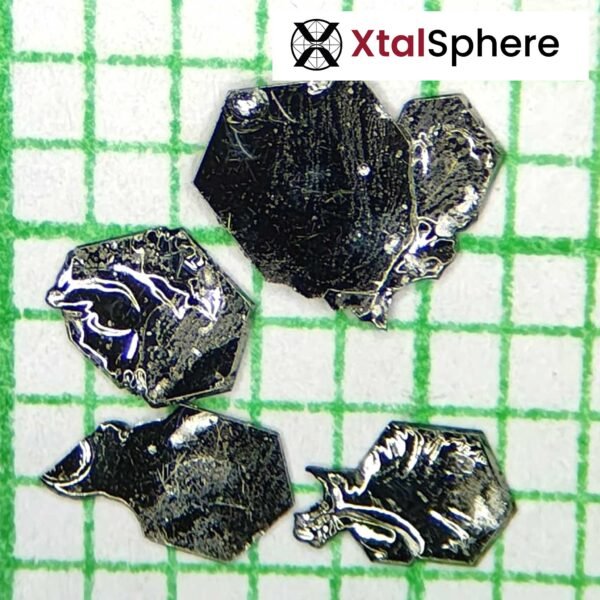
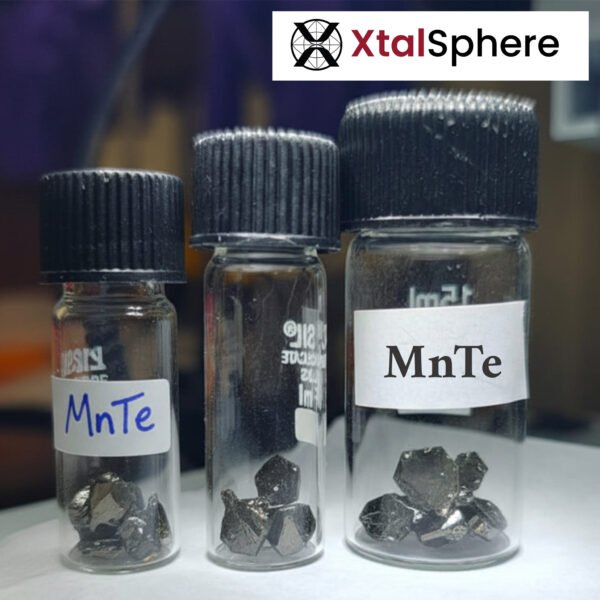
Overview:
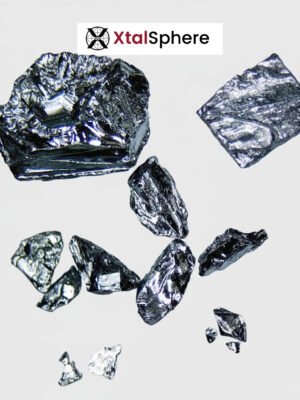
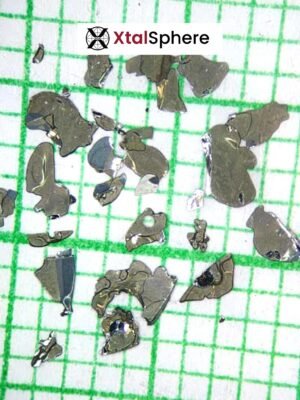
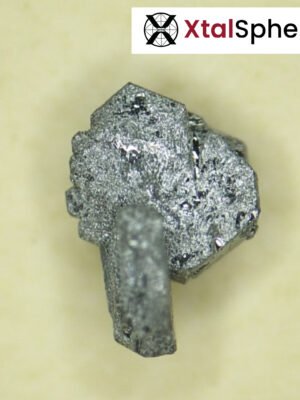
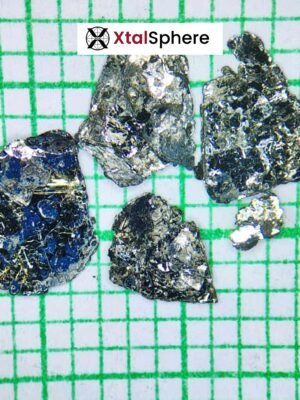
High-quality MnTe single crystals grown via controlled solid-state synthesis and flux techniques. Exhibits antiferromagnetic order (~310 K) and p-type semiconducting behavior, ideal for spintronic and topological studies.
Characterization:
✔ Phase purity confirmed by XRD and Raman spectroscopy
✔ EDS and ICP-MS verify 1:1 Mn:Te stoichiometry
✔ Hall effect shows p-type conduction (~10¹⁸ cm⁻³)
✔ Linear M–H and semiconducting ρ–T behavior confirm AFM nature
Applications:
Quantum materials research, spintronics, thermoelectrics, and AFM semiconductor devices.
Chemical Formula: MnTe
Crystal Structure: Hexagonal (NiAs-type)
Growth Method: Self-flux / Modified Bridgman Method
Purity: ≥ 99.999% (metals basis, verified via EDS & ICP-MS)
Availability: Single Crystal Form (as-grown plates or oriented slabs)
For orders and inquiries: contact@xtalsphere.com
Manganese Telluride (MnTe) is a p-type antiferromagnetic semiconductor that has recently attracted attention for its spintronic, magneto-transport, and thermoelectric applications.
At room temperature, MnTe crystallizes in the NiAs-type hexagonal structure, showing collinear antiferromagnetic ordering below ~310 K (Néel temperature).
The delicate balance between its magnetic order and carrier transport makes MnTe a model system to study magneto-electric coupling and magnetic topological behavior.
High-quality MnTe single crystals are grown at Xtalsphere through solid-state reaction followed by controlled slow cooling.
We ensure:
Ultra-pure elemental precursors (≥99.999%)
Optimized temperature profiles for homogeneous melt growth
Oxygen-free sealed ampoule synthesis
Natural cleavage along (0001) planes for smooth, mirror-like crystal surfaces
Xtalsphere’s MnTe crystals undergo comprehensive structural and physical property analysis:
Powder & Single-Crystal XRD: Confirms phase purity and crystallographic orientation (space group P6₃/mmc).
Raman Spectroscopy: Identifies characteristic phonon modes near 120–170 cm⁻¹.
SEM–EDS: Shows uniform grain morphology and elemental stoichiometry close to 1:1 Mn:Te ratio.
Laue Diffraction: Used for orientation verification in single crystals.
Resistivity (ρ-T): Displays semiconducting behavior with resistivity increasing with decreasing temperature.
Hall Effect: Positive Hall coefficient indicating p-type conduction.
Typical room-temperature carrier concentration: ~10¹⁸ cm⁻³.
Magnetoresistance: Small positive MR below the Néel temperature due to spin-scattering suppression.
All transport measurements are carried out using PPMS (Quantum Design) systems to ensure accuracy and reproducibility.
Antiferromagnetic transition (Tₙ): ≈ 310 K
Magnetization (M–H): Linear with applied field below Tₙ, confirming AFM order.
No parasitic ferromagnetism detected — indicative of high crystal quality and chemical homogeneity.
Xtalsphere ensures research-grade purity through:
Controlled atmosphere synthesis
ICP-MS verification of trace impurities
No secondary phases observed in XRD or EDS mapping
Each crystal batch is individually characterized and documented before dispatch.
Quantum & spintronic research
Antiferromagnetic semiconductors
Thermoelectric studies
Thin-film heterostructure seed crystals
Reviews
There are no reviews yet.